The best D-day books: our top 10
From Cornelius Ryan's The Longest Day to Antony Beevor's D-Day, discover our top 10 D-Day books — essential reading for anyone who wants to understand 6 June 1944.
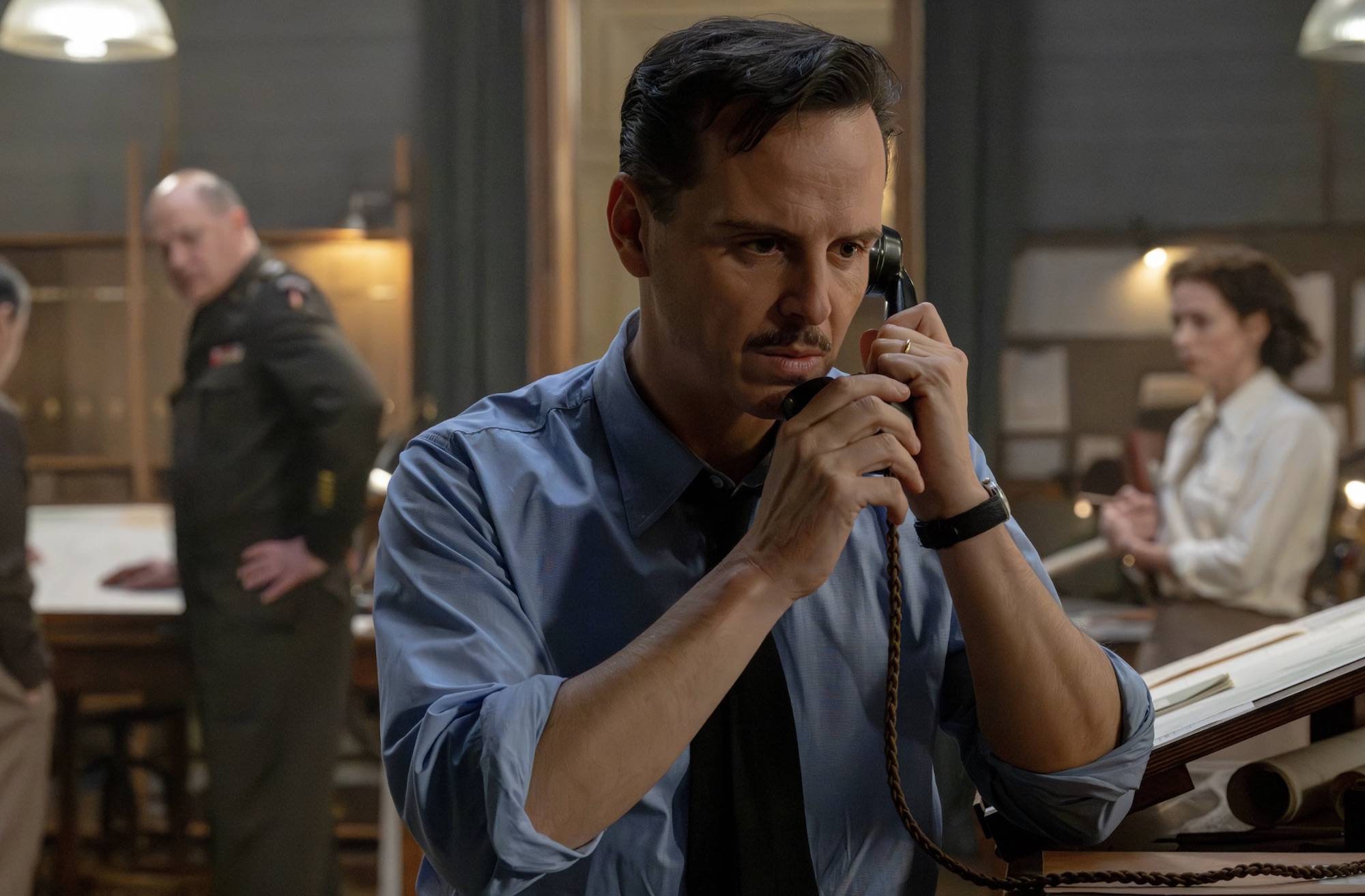
When we covered the true story behind Pressure back in August, the big question was whether a film about a weather forecast could hold your attention for two hours. The film has been playing in Belgian and Dutch cinemas since 10 September, and we went to see it ourselves. The short answer: yes, it can. The long answer — what makes the film so good, and what is and isn’t historically accurate — is below.
Pressure is not a Hollywood film full of spectacle. Barely a shot is fired, and there is no beach full of landing craft: an estimated eighty percent of the film takes place inside the Allied operations quarters. And yet the film is never boring for a single moment. Director Anthony Maras draws his tension not from action but from the pressure resting on one man’s shoulders: Group Captain James Stagg, the meteorologist who has to tell General Eisenhower whether the largest invasion in history can go ahead.
Precisely because it stays so close to reality — the weather charts, the conflicting forecasts, the briefings reconvening every few hours — you genuinely live through that pressure as a viewer. Anyone who has read our article on the weather forecast of D-day knows that tension wasn’t invented; the film simply makes it palpable.
Andrew Scott delivers a James Stagg you won’t soon forget. His personality — dour, scientific, largely indifferent to rank or hierarchy — is portrayed superbly, and you watch him gradually buckle under fatigue and doubt without it ever becoming theatrical.
Brendan Fraser is wonderful as Eisenhower. His often emotional voice makes the inhuman weight of the decision — more than 150,000 lives hanging on a single weather report — all the more believable. And Damian Lewis is every bit as strong as Bernard Montgomery, who in this film plays something of the antagonist, or even the villain: the general who wants to launch at any cost and waves away Stagg’s doubts.
What gives the film its extra charge is the family storyline running parallel to the military one: Stagg’s heavily pregnant wife is in hospital, and because of the secrecy surrounding the operation he cannot be with her and doesn’t know her condition. That personal uncertainty, on top of the sleepless nights, pushes him towards breaking point.
It produces the strongest scene in the film: an exhausted Stagg who casts aside his reserve and shame and, in full emotion, speaks his mind to the supreme commanders. It is exactly that outburst that helps push Eisenhower over the line to postpone the landings by 24 hours — from 5 to 6 June.
As always at D-day Info, we hold the film up against the history books. Here is what’s accurate — and what has been dramatized:
The weather forecast itself: accurate. There really were three separate forecasting teams drawing different conclusions from the same limited data, and the American Irving Krick genuinely was more optimistic about 5 June than Stagg. On the evening of 4 June, Stagg identified the narrow window of clearing weather that led Eisenhower to postpone the invasion by 24 hours. You can read the full true story in our article on the weather forecast of D-day.
Montgomery as the opponent: largely true. Historically, Montgomery did indeed want to go on 5 June, even as the weather turned doubtful. The film somewhat inflates his role as antagonist — in reality he accepted the decision — but the core of the conflict is authentic.
The hospital subplot: true at its core, dramatized in its timing. Stagg’s wife really was pregnant, and the secrecy really did keep him from being with her or receiving any news. But where the film ends with a reunion with his newborn son, in reality their son was born months after D-Day. The emotional weight is real; the perfect timing is cinema.
The aftermath: accurate, and if anything understated. Had Eisenhower postponed again, the next viable window would have fallen on 17-19 June — the exact days a historic storm battered the Channel and wrecked the artificial Mulberry harbours. Eisenhower afterwards scribbled a note to Stagg thanking the gods of war they went when they did.
Pressure proves you don’t need beaches full of special effects to make a gripping D-Day film. A map room, a handful of excellent actors and a true story more suspenseful than fiction are enough. The film has been well received internationally too — 87% on Rotten Tomatoes and an “A” CinemaScore from audiences — and as far as we’re concerned, deservedly so.
For anyone with even a passing interest in D-Day: highly recommended. And if you leave the cinema wanting to know how it really happened, you’ll find the full story behind the film right here.
1. Not a spectacle film but a nerve-racking thriller set in the operations quarters
2. Andrew Scott shines as the dour, exhausted James Stagg
3. Brendan Fraser makes the weight of Eisenhower’s decision tangible
4. Damian Lewis convinces as the obstinate Montgomery
5. Remarkably accurate historically — only the family subplot is embellished
6. 87% on Rotten Tomatoes, and deservedly so
Read the true story behind Pressure here
Read how the weather forecast decided D-day here
Check out the best D-day movies – Top 10 here
The film is based on David Haig’s 2014 stage play. Want to read the original? Order “Pressure: The Original Play” on Amazon.
This article contains affiliate links: if you order through one of these links, we may earn a small commission at no extra cost to you.
Have you noticed a language or writing error? Please let us know, as this will only improve our reporting. We will correct them as soon as possible. Your personal data will be treated confidentially.
Report error
Use discount code DDAYINFO and get 30% discount on everything.